
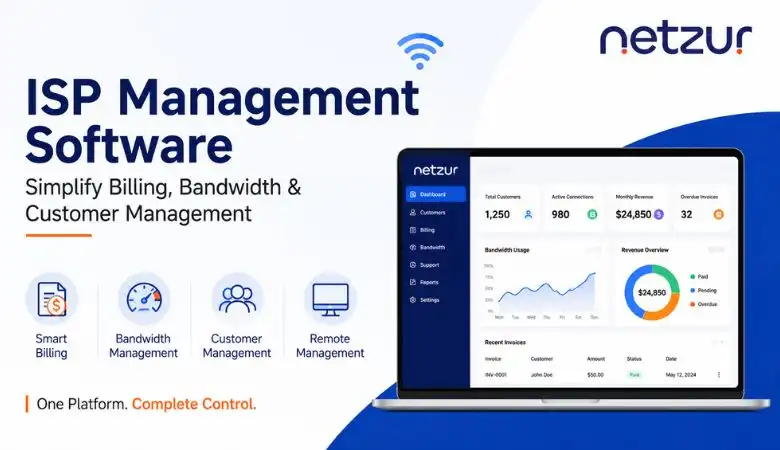
As customer expectations continue to climb, the internet service market is getting more competitive. In order to maintain operational efficiency, Internet service providers (ISPs) must manage users, keep an eye on network performance, manage billing, and offer flawless customer care. ISP management software is essential in this situation.
Network infrastructure alone is not enough for a modern ISP to be successful. It requires an integrated system that lowers administrative workloads, enhances client experiences, and automates daily operations. Providers may simplify invoicing, bandwidth allotment, customer administration, and network monitoring from a single platform with the use of an advanced ISP management system.
The Increasing Demand for Software for ISP Management
Maintaining manual processes becomes challenging as subscriber bases increase. Using spreadsheets or unconnected technologies to manage hundreds or thousands of users frequently results in inefficient bandwidth distribution, delayed support answers, and billing mistakes.
An efficient ISP management software program allows providers to automate important duties and centralise operations. Teams may now concentrate on customer happiness, service quality, and business expansion rather than tedious administrative tasks.
Making Billing Processes Easier
Managing subscription plans and recurring payments is one of the main issues facing ISPs. The whole billing lifecycle is automated by contemporary ISP billing and bandwidth management software.
Among the main advantages are:
- Automated creation of invoices
- Adaptable administration of subscription plans
- Tracking payments in real time
- Management of taxes and discounts
- Integration of multiple payment gateways
- Automated suspension and restart of services
ISPs can lower billing errors, enhance cash flow, and give clients a smooth payment experience by automating these procedures.
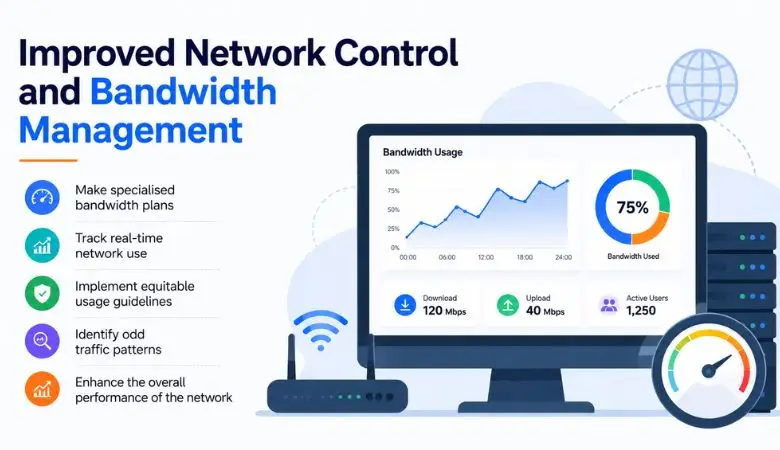
Improved Network Control and Bandwidth Management
Maintaining network performance and customer satisfaction requires effective bandwidth distribution. In order to avoid network congestion, ISPs must guarantee that customers receive the services they pay for.
With sophisticated ISP billing and bandwidth control software, service providers can:
- Make specialised bandwidth plans.
- Track real-time network use
- Implement equitable usage guidelines
- Identify odd traffic patterns
- Enhance the overall performance of the network
ISPs can provide their clients with a more dependable and consistent internet experience by implementing automated bandwidth control.
Improving Customer Service
Customer retention is significantly influenced by subscriber satisfaction. Providers can handle the complete client lifecycle, from onboarding to support, with the use of an integrated ISP customer management software package.
Features frequently consist of:
- Management of customer profiles
- Activation and delivery of services
- Ticketing and assistance administration
- Tools for notice and communication
- Monitoring service history
Support teams can fix problems more quickly and give customers a better overall experience when all customer information is in one location.
A Service Provider Remote Management Platform’s Significance
These days, ISPs frequently oversee numerous sites, distant network equipment, and dispersed personnel. Operators can monitor and manage network infrastructure from any location with the help of a dependable service provider remote management platform.
Advantages consist of:
- Monitoring devices remotely
- Notifications and alerts in real time
- Quicker troubleshooting
- Decreased downtime
- Increased effectiveness of operations
Providers can reduce operating expenses and preserve service dependability with the use of remote management capabilities.
Integration of MikroTik for ISP Functions
MikroTik routers are used by several ISPs to operate their networks. By selecting an ISP billing program with MikroTik integration, providers can automate service provisioning, bandwidth distribution, and subscriber identification.
The following are some benefits of MikroTik integration:
- Automated administration of users
- Controlling bandwidth dynamically
- Account synchronisation in real time
- Network administration made simpler
- Lower levels of manual intervention
ISPs are able to provide a more effective and scalable network management environment because of this integration.
Why Integrated Platforms Are Selected by Contemporary ISPs
Inefficiencies are frequently caused by using different technologies for network monitoring, client management, and billing. These crucial tasks are combined into a single platform by a unified ISP management system, which increases operational visibility and control.
Providers benefit from integrated solutions:
- Boost the effectiveness of operations
- Minimise the amount of administrative work
- Increase client satisfaction
- Boost the expansion of your company
- Expand services in a more efficient manner
A centralized management platform gives internet service providers a tactical edge as competition grows.
Conclusion
An ISP’s capacity to effectively handle clients, billing, bandwidth, and network infrastructure determines its level of success. Through automation and centralised control, contemporary ISP management software streamlines these crucial procedures.
Providers are able to provide better services while lowering operational complexity thanks to solutions like ISP customer administration software, ISP billing and bandwidth management software, and a strong service provider remote management platform.
Comprehensive solutions are provided by platforms like Netzur to assist ISPs in streamlining operations, enhancing subscriber experiences, and fostering long-term company success. In an increasingly competitive digital environment, providers can maintain their competitiveness by investing in the appropriate ISP management system.