
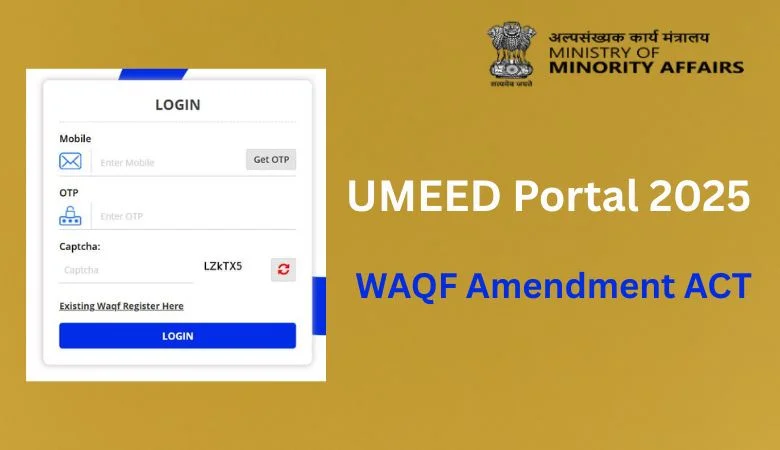
The Ministry of Minority Affairs, under the government of India, created the Umeed portal. The Umeed portal aims to enhance transparency and accountability for waqf properties.
All Waqf properties will be visible on the Umeed portal once applications from Waqf officials across India have fully uploaded the information.
What is the Umeed Portal?
In simple words, Umeed is a Centralized digital platform to manage Waqf property data.
The Indian government launched the Umeed portal in 2025 following the passage of a Waqf amendment bill. At the Umeed portal, all existing Waqf properties must be digitized and uploaded to the Umeed website, which is officially called the Unified Waqf Management, Empowerment, Efficiency, and Development Act (abbreviated UWMEEDA).
The Ministry of Minority Affairs launched the Unified Waqf Management, Empowerment, Efficiency, and Development Act, 1995 (UMEED) Central Portal on June 6, 2025, and the deadline for submissions/uploading is December 5, 2025.
Why is the Umeed Portal Important?
Ummed portal is a significant step towards the modernization of waqf administration. A UWMEEDA portal allows for the management of Waqf properties through a unified platform for registration, verification, legal tracking, and revenue monitoring.
The Waqf properties can be managed and accessed directly online without any chaos; there will be no issues of property disputes. The Umeed Portal will make all properties visible online; it prevents data manipulation and promotes accountability.
The Umeed portal system enables online account files and real-time audits and trust.
Who can Apply to the Umeed Portal?
The one who has the role of president or Mutawalli of a particular Waqf property can register their name and has to upload the required legal documents.
- Mutawallis (Managers/Admins of Waqf Properties)
- NGOs (Waqf Institutions)
Waqf properties include various facilities such as mosques, madrasas, schools, NGOs, dargahs, chillahs, and more, all managed by Muslims for the development of the Muslim community.

How to Register Waqf property on the Umeed Portal?
The registration process for the Umeed portal is easy and can be done with the help of internet connectivity and a device, like a PC, laptop, or tablet. The registration process is taking place at Waqf offices all over India.
Here is the simple process for Umeed portal waqf registration:
- Visit the Umeed website: umeed.minorityaffairs.gov.in
- Register with a name and mobile number, enter the OTP and Verify
Fill out the Umeed portal full form with the following details:
- First Name – Last Name
- Mobile Number
- Mail ID
- Religion
- State
- Nationality
- Address
- Pin Code
- Highest Education
- Employment Status
- ID Proof: Aadhar, PAN Card, Voter ID
- Upload these documents: Appointment letter from Waqf Board/Waqf Deed/Board Order document
- Upload a passport-size photo
After filling in the details and uploading documents, fill in the captcha below and submit to proceed.
Done, your registration process is finished here. The officers will examine all the details and approve if everything is legal and accurate, and it will be visible on the Umeed website.
For more detailed information on the applying process and required documents, you can visit the official website of Umeed (umeed.minorityaffairs.gov.in). Also, you can see and download the umeed portal form by below link.
You can download the full form of the Umeed portal in both English and Urdu. Find the link below.
If you don’t know what the Waqf Board and Waqf Amendment Act are. We are penning down what they mean.
What is a Waqf Board?
A Waqf Board is a legal entity that can acquire, hold, protect, and manage Waqf properties. It also has powers to recover lost or encroached Waqf properties and to sanction major transactions (sale, lease, mortgage, exchange)—though permanent sale or giving away a Waqf is generally prohibited.
Waqf properties across India mosques, graveyards, schools, lands, etc.—need to have a system to manage them properly. That’s where a “Waqf Board” comes in. Every state in India houses a Waqf Board, and a central advisory body oversees minority affairs within the government.
The Board appoints custodians/administrators, also called mutawalli in a urdu local language, to manage day-to-day affairs and ensures that the income or benefits from Waqf properties are used for their intended charitable or religious objectives.
In 1995, the Waqf Act, 1995, was implemented to better regulate Waqf properties, updating administration, powers of Waqf Boards, setting up special Waqf Tribunals (in place of civil courts) for Waqf disputes, and strengthening central supervision.
What is the 2025 Waqf Amendment Act?
Over time, the Waqf system faced many problems, like misuse, illegal transfer, encroachments, lack of transparency, confusion over ownership or status of properties, and long legal disputes. The government argued that reforms were required to make management more transparent, effective, and accountable.
The Waqf Act underwent changes and new implementations from 1995 to 2025. The Act renames or rebrands the law as the Unified Waqf Management, Empowerment, Efficiency, and Development Act (UWMEEDA), 1995 (with amendments)—reflecting that the law has been updated.
The 2025 Act aims to modernize the Waqf system by making it more transparent, reducing misuse or encroachments, ensuring better management of Waqf properties, and preserving the endowment’s religious or charitable purpose; this is where the UMEED portal was launched under the 2025 Waqf Amendment Act.
Umeed Portal Date Extension – Last Date Update
At present the Umeed portal is facing a server issue due to most of the files being pending to upload, and the last date is 05th Dec, 2025 the people who have still not updated their documents in Umeed are in tension. Muslims are hoping for the extended date to give some time for applicants.
151,000-plus registers are done until now, and it’s still processing on umeed portal, said Kiran Rijiju. The most registered are in Karnataka, Punjab, and Jammu and Kashmir.
The decision about extending the date of the Umeed portal can be made by the Waqf Tribunal, which is available in all the states of India.