

Every few months, a fresh wave of crypto investors types the same question into a search bar: when is XRP going to go back up?
Right now, that question feels especially urgent — the token has shed roughly 40% from its 2025 high, leaving many holders sitting on significant paper losses while wondering whether the bottom is already in.
The short answer is that no one can predict the exact timing, but a convergence of institutional momentum, cleared legal hurdles, and shifting supply dynamics gives analysts more reason for optimism than at almost any point in the past four years.
Billions in Fresh Institutional Capital Are Flowing In
The launch of spot XRP exchange-traded funds in late 2024 marked a turning point that many retail investors have underestimated.
These products don’t just add convenience — they redirect money from pension funds, endowments, and wealth management platforms that were previously locked out of crypto entirely.
Nearly $1.37 billion has entered through these vehicles since approval, with 29 consecutive sessions of net buying recorded through the end of 2025.
Think of it like a faucet being turned on: traditional finance now has a clean, regulated way to gain XRP exposure, and early data suggests that faucet isn’t turning off anytime soon.
If you’ve been tracking when will XRP go up and wondering what could finally flip the trend, sustained institutional buying through ETFs is historically one of the most reliable precursors to a prolonged rally — Bitcoin’s 90% climb in the year after its own spot ETF approval offers the closest comparison.
The Legal Overhang That Suppressed XRP for Years Is Gone
Imagine trying to sell a house while it’s under active investigation — that’s essentially what Ripple dealt with for years while the SEC lawsuit hung over the token.
That changed in 2025 when the SEC dropped its appeal and settled for $125 million, far less than the $2 billion it originally demanded.
The new SEC leadership under Paul Atkins, known for pragmatic crypto regulation, signals that the hostile enforcement era is likely over.
Banks and payment processors — the very institutions Ripple needs as customers — can now explore XRP-based settlement rails without worrying their compliance teams will shut the project down.
For investors curious about the real-time impact of this shift, keeping an eye on the live XRP price chart helps connect macro regulatory news to actual market behavior as it unfolds.
Reading the Charts: Two Patterns That Matter Right Now
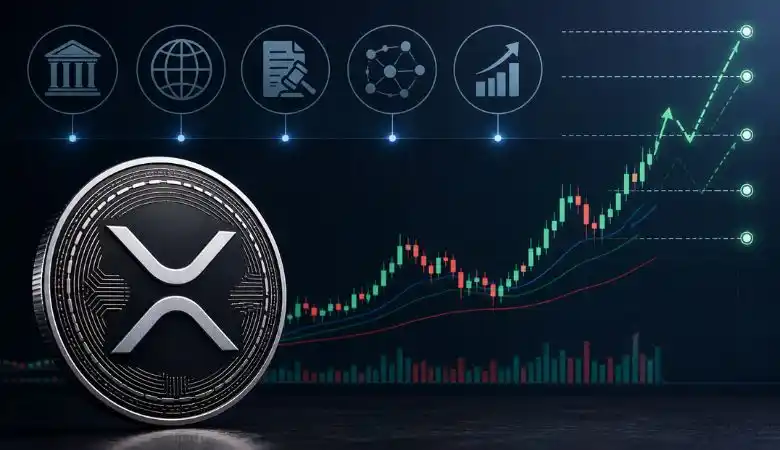
Technical analysts aren’t looking at XRP’s chart and seeing chaos — they’re spotting familiar formations that have historically marked the end of extended corrections.
The first is a falling wedge breakout near the $2.05–$2.10 zone, a pattern that tends to resolve upward and projects an initial move toward $2.60–$2.70.
The second is a Wyckoff reaccumulation structure — a multi-phase cycle where price shakes out weak holders with a sharp dip (in this case down to $1.70 in late 2025) before smart money quietly rebuilds positions.
XRP is currently testing what Wyckoff analysts call the “creek” — resistance between $2.10 and $2.15 — and a clean break above that band would signal entry into the markup phase, pointing toward $2.80–$3.20 in the near term and potentially $7 over a longer horizon.
The 200-day exponential moving average sits near $2.35 and acts as the clearest single line in the sand: reclaiming it would likely trigger momentum-driven buying from traders who follow that indicator religiously.

A Supply Squeeze Is Building Quietly
While price charts get most of the attention, one of the more compelling behind-the-scenes developments is what’s happening to XRP’s exchange supply.
Coins held on trading platforms — the ones available for immediate sale — have dropped to levels not seen since 2018.
When available supply shrinks and buying demand holds steady or grows, basic market mechanics push prices higher faster than they would under normal conditions.
Combine that tightening with the steady institutional absorption happening through ETFs, and you get a setup where even a moderate uptick in demand could produce an outsized price response.
What Analysts Are Actually Projecting
Standard Chartered’s Geoffrey Kendrick has staked out the most bullish position among major institutions, forecasting XRP at $8 by end of 2026 — roughly 300% above recent trading levels — and $12.50 by 2028.
More measured analysts see a year-end 2026 target closer to $3, which still represents a meaningful return if XRP clears its near-term resistance.
Ripple CEO Brad Garlinghouse has projected capturing 14% of SWIFT cross-border payment volume within five years, but actual transaction volumes have declined recently — a gap between the vision and current execution that more cautious forecasters point to as a reason for restraint.
The realistic range for late 2026 appears to be $3 on the conservative end and $8 on the optimistic end, with the outcome hinging on whether real-world payment adoption catches up to the narrative.
Worth noting: targets like $50 or $1,000 per XRP are mathematical impossibilities at current supply levels — they would require market capitalizations larger than the entire 2021 global crypto market combined.
The Headwinds Are Real Too
PayPal, Visa, and other established payment networks aren’t sitting still while Ripple builds its customer base — they have existing infrastructure, regulatory relationships, and brand trust that blockchain projects are still working to match.
XRP’s volatility also cuts both ways: the same conditions that could produce a sharp rally also produced a 42% drop in just a few weeks during early 2025.
Ripple’s RLUSD stablecoin is entering a market dominated by USDC and Tether, and weak adoption there could slow the broader ecosystem growth that XRP’s bullish case depends on.
Conclusion
The case for XRP’s recovery isn’t built on hype — it rests on a specific set of measurable developments: $1.37 billion in ETF inflows, a resolved SEC lawsuit, tightening exchange supply, and technical chart patterns that have historically preceded sustained rallies.
A grounded base case puts XRP in the $2.50–$3.00 range by mid-2026, with a more optimistic path to $5–$8 if institutional adoption accelerates alongside a broader market upswing.
The $2.35 resistance level is the number worth bookmarking — how XRP handles that zone in the coming weeks will likely determine which scenario plays out.