
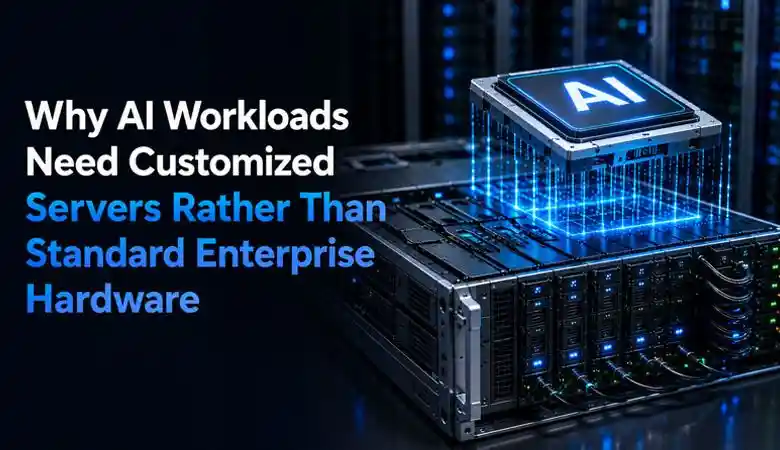
Artificial intelligence has moved from experimental labs into mission-critical enterprise environments. Yet many organizations still attempt to run modern AI workloads on traditional infrastructure designed for transactional databases, virtualization, and standard business applications. The result is often disappointing performance, escalating costs, and frustrated engineering teams. Training and serving large models demand a fundamentally different hardware approach. Customized servers built around the unique demands of AI deliver the throughput, parallelism, and efficiency that off-the-shelf systems cannot match. This article examines why customized servers have become essential and how decision-makers can plan smarter deployments without overspending on the wrong infrastructure.
Why Traditional Enterprise Servers Struggle with Modern AI Workloads
Standard enterprise servers were engineered for predictable, CPU-bound workloads such as ERP systems, file services, and virtual machine hosts. They prioritize reliability, balanced I/O, and general-purpose compute. AI behaves nothing like these workloads. It is data-intensive, parallel by nature, and extremely sensitive to bottlenecks across every layer of the stack.
The Processing Demands of AI Models
Training a transformer-based model or running real-time inference involves billions of matrix operations executed simultaneously. A traditional dual-socket CPU server, no matter how many cores it has, will serialize much of this work. Without dedicated accelerators, even modest models can take days to train instead of hours. CPUs were never designed for the dense linear algebra of deep learning, which is why customized servers with proper GPU integration have become the default choice.
Storage and Memory Bottlenecks
Beyond raw compute, AI is constrained by how quickly data can move. Standard SATA SSDs and conventional DDR memory channels often choke on the throughput requirements of large datasets. When a GPU sits idle waiting for data, the entire economic case for AI infrastructure collapses. High memory bandwidth, NVMe storage tiers, and fast interconnects such as PCIe Gen5 or NVLink are prerequisites, not luxuries.
What Makes Customized Servers Ideal for AI Applications
Rather than forcing AI workloads into a generic chassis, customized servers align every component with the model architecture, dataset size, and deployment goals.
GPU Acceleration and Parallel Computing
Purpose-built gpu servers for ai are at the heart of any serious deep learning environment. Whether training foundation models, fine-tuning open-source LLMs, or deploying inference at scale, multi-GPU configurations with adequate VRAM and high-bandwidth interconnects deliver order-of-magnitude performance gains. A system designed around four or eight accelerators behaves nothing like a server with a single card bolted onto a generic platform.
Flexible Resource Allocation
Different AI projects require different balances of CPU cores, GPU count, memory capacity, and storage throughput. A computer vision pipeline has different needs than a recommendation engine or a retrieval-augmented generation system. Customized servers allow architects to right-size each variable independently, eliminating waste and avoiding the overprovisioning that plagues fixed enterprise SKUs.
Optimized Cooling and Power Efficiency
Dense GPU deployments generate substantial heat and draw considerable power. Standard 1U or 2U enterprise chassis often lack the airflow, redundant power capacity, or thermal design needed to sustain high utilization. A custom built server can integrate optimized cooling, higher-wattage power supplies, and rack layouts that prevent thermal throttling under sustained load.
Cost Considerations: New vs Refurbished Infrastructure

AI infrastructure budgets can spiral quickly, particularly when teams default to the latest flagship GPUs. Smart organizations evaluate both new and pre-owned options based on workload requirements rather than assumptions.
When a Refurbished Server Makes Sense for AI Projects
A refurbished server, properly inspected and reconfigured, can deliver excellent value for development environments, inference clusters, and pilot deployments. Previous-generation GPUs still provide meaningful acceleration for many production workloads. By pairing refurbished chassis with newer accelerators, storage, or networking, organizations can stretch budgets without sacrificing performance. Many efficient customized servers in production today combine refurbished and new components in a single balanced configuration.
The Strategic Benefits of a Custom Built Server
Choosing a custom built server is not merely a hardware decision, it is a strategic one. Off-the-shelf enterprise systems force teams to adapt their workloads to fixed configurations. Customized servers invert that relationship, letting the workload dictate the architecture.
Future-Proofing AI Infrastructure
AI moves faster than almost any other discipline in enterprise IT. Model sizes grow, frameworks evolve, and accelerator generations turn over rapidly. A configurable platform with adequate PCIe lanes, expansion bays, and power headroom can absorb the next generation of GPUs or NVMe drives without a costly rip-and-replace.
Choosing the Right Server Configuration for AI Success
Selecting the right configuration begins with an honest evaluation of the workload: model size, dataset volume, training frequency, latency requirements, and expected growth over time. These factors directly influence decisions around GPU selection and quantity, memory bandwidth, NVMe storage capacity, high-speed networking, and thermal management design.
Partnering with experienced specialists ensures every component is aligned with real-world requirements when you build your server. At Zaco Computer, infrastructure planning focuses on matching hardware precisely to workload demands so that performance is maximized without unnecessary overspending. The most effective customized servers are not necessarily the most expensive. they are the ones engineered specifically for the problem they are intended to solve.
Conclusion
AI workloads have outgrown the assumptions baked into traditional enterprise hardware. From GPU acceleration and memory bandwidth to storage performance and thermal design, every layer of the stack benefits from intentional engineering. Customized servers whether built from new components or thoughtfully assembled with refurbished elements give organizations the flexibility, performance, and cost discipline that modern AI demands. By matching infrastructure to workload, IT leaders can deliver AI initiatives that scale predictably, perform reliably, and remain financially sustainable.