
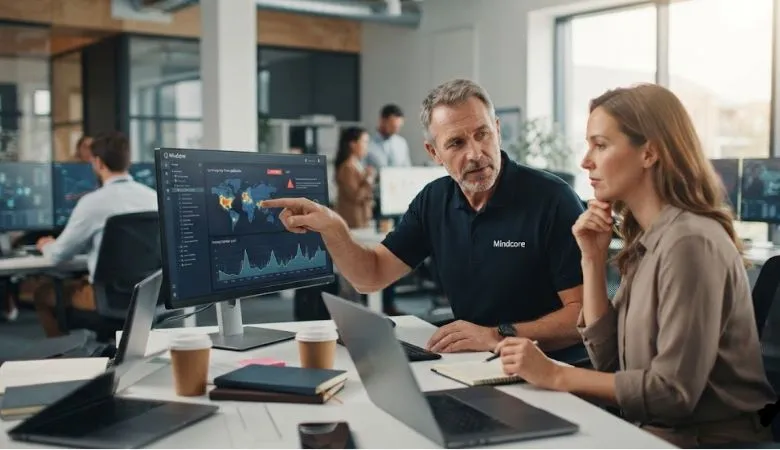
For years, advanced IT and cybersecurity capabilities were largely the domain of large enterprises with the budgets to build dedicated security operations centers and specialized monitoring teams. That gap has started to close, not because small businesses suddenly have enterprise-level budgets, but because AI has made certain capabilities dramatically more accessible and affordable than they used to be.
This shift is changing what small and mid-sized businesses can reasonably expect from their IT and security setup, and it is worth understanding what has actually changed rather than treating it as another vague technology buzzword.
Why AI Changes the Economics of Threat Detection
Traditional security monitoring relied heavily on either automated rules that flagged known threat patterns or human analysts reviewing activity manually. Both approaches have real limitations. Rule-based systems miss novel threats that do not match a known signature, and human analysts, however skilled, cannot manually review the volume of activity a modern network generates.
AI-powered monitoring tools address both limitations by learning what normal activity looks like for a specific environment and flagging genuine anomalies without requiring a human to review every single data point. This does not eliminate the need for skilled security professionals, but it changes what those professionals can realistically monitor, since AI handles the initial filtering that would otherwise consume enormous amounts of human attention.
What This Actually Looks Like in Practice for a Small Business
For a small or mid-sized business, this shift shows up as monitoring capabilities that would previously have required a dedicated security team to achieve. Suspicious login patterns, unusual data transfers, or abnormal network activity can be flagged and investigated far faster than a purely manual process would allow, without requiring the business to hire a large internal security staff to get that level of coverage.
This matters because the businesses most likely to fall victim to a serious cyber attack are often the ones without the resources to build extensive internal security monitoring. AI-powered tools are narrowing that gap by making a meaningful level of monitoring accessible at a cost that fits a small business budget, rather than only being available to organizations with enterprise-level resources.
AI in IT Infrastructure Management, Not Just Security

Beyond security, AI is changing how routine IT infrastructure management gets handled. Predictive maintenance tools can flag hardware that is likely to fail before it actually does, based on patterns that would be difficult for a human to notice manually. Automated ticket triage can route support requests to the right specialist faster, reducing the time between when an issue is reported and when someone with the right expertise starts working on it.
None of this replaces the judgment of skilled IT professionals, but it reduces the amount of routine, repetitive work those professionals need to handle manually, freeing their attention for the more complex issues that actually require human expertise.
Why Human Oversight Still Matters
AI-powered tools are most effective when paired with skilled people who understand how to interpret and act on what those tools surface. An AI system can flag an unusual pattern, but deciding whether that pattern represents a genuine threat, a false positive, or a legitimate but unusual business activity still requires human judgment informed by context the AI does not have.
Businesses that treat AI as a complete replacement for human oversight, rather than a tool that makes human oversight more effective, tend to see less value from the investment than businesses that use AI to extend what their existing team can accomplish.
What to Look for When Evaluating AI-Powered IT Providers
Not every provider that advertises AI capabilities is using them in a way that actually benefits a business. It is worth asking specifically what the AI tools are monitoring, how alerts are reviewed and acted on, and whether a human is actually involved in the decision-making process when something significant is flagged. A provider that can explain this clearly is generally applying the technology more thoughtfully than one offering a vague description of “AI-powered security” without specifics.
How Mindcore Technologies Applies AI to IT and Cybersecurity
Mindcore Technologies has spent more than 30 years helping businesses build the IT and security foundations that keep pace with how technology is actually evolving. Under the leadership of Matt Rosenthal, CEO of Mindcore Technologies, the company delivers AI-powered IT and cybersecurity solutions that combine AI-driven monitoring with the human expertise needed to interpret and act on what that monitoring reveals.
Businesses working with Mindcore get the benefit of AI-enhanced threat detection and infrastructure management, backed by a team that understands how to apply those tools effectively rather than relying on the technology alone.
Conclusion
AI is genuinely changing what small and mid-sized businesses can expect from their IT and security setup, closing a gap that used to separate them from the monitoring capabilities large enterprises have long had access to. The businesses getting the most value from this shift are the ones pairing AI-powered tools with skilled professionals who know how to act on what those tools surface, rather than treating the technology as a standalone solution.
About the Author
Matt Rosenthal is the CEO and President of Mindcore Technologies, a full-service IT consulting and cybersecurity firm serving businesses across Florida, New Jersey, Maryland, South Carolina, Louisiana, Texas, and nationwide.
With more than 30 years of experience in IT leadership, managed services, and technology strategy, Matt has helped organizations across healthcare, financial services, and professional services apply AI-powered tools effectively within a well-managed, human-supervised IT strategy. He holds an MBA in Technology Management, is a certified Project Management Professional (PMP), and is the host of Digging In, a weekly podcast on success in business, life, and health.