
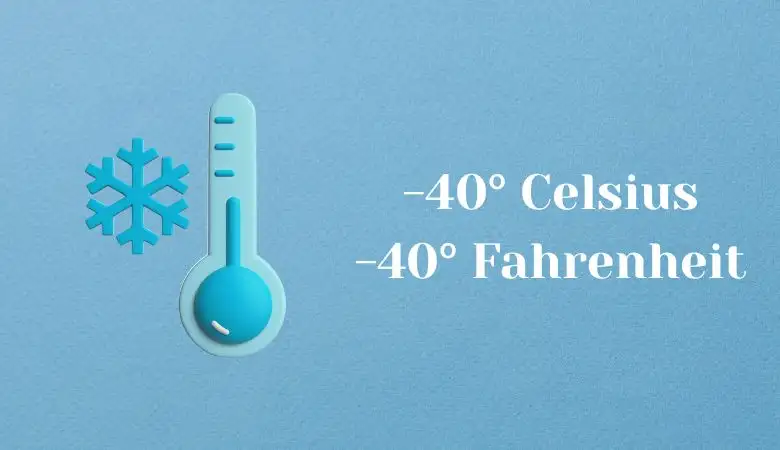
When people discuss cold weather, they often use two main units: Celsius (°C) and Fahrenheit (°F). This can be confusing, especially when the numbers are below zero. You might wonder which is colder: minus 40°c or minus 40°f?
After all the research and reading the books related to climate, temperature, and atmosphere, here we have published an article, which makes the reader gain knowledge on topics like Celsius and Fahrenheit.
The quick answer is:
- At −40, Celsius and Fahrenheit are exactly the same.
- Therefore, −40°C and −40°F are equal. One is not colder than the other.
But to really understand this, it helps to know more about temperature scales, climate, and what extreme cold does to the human body.
What Does Minus 40 Feel Like?
At −40°C (or −40°F), the air is extremely cold:
- Your breath turns to visible fog right away.
- Water can freeze almost instantly.
- Skin exposed to the air can start to freeze in minutes.
- Metal feels painful to touch with bare hands.
This is a level of cold you usually find in places like the Arctic, Siberia, or during very strong winter storms in some parts of North America and Northern Asia.
Celsius vs Fahrenheit: Basic Ideas
To answer “which is colder: minus 40°c or minus 40°f”, we must first know what these scales (Celsius and Fahrenheit mean).

Celsius (°C)
- Used in most countries in the world.
- 0°C is the freezing point of water.
- 100°C is the boiling point of water.
- Common in weather reports outside the United States.
Fahrenheit (°F)
- The term is primarily used in the United States and a few other locations.
- 32°F is the freezing point of water.
- 212°F is the boiling point of water.
- Many people consider it useful for everyday weather, because the numbers often sit in a “comfortable” range (for example, 60–80°F).
How Celsius and Fahrenheit Compare
You can convert between Celsius and Fahrenheit using the following formula:
1. From Celsius to Fahrenheit: F=9/5C+32
2. From Fahrenheit to Celsius: C=5/9(F−32)
If you put −40 into either formula, you get:
F=9/5(−40)+32=−72+32=−40
C=5/9(−40−32)=5/9(−72)=−40
So −40°C = −40°F.
Celsius vs Fahrenheit Around −40
| Celsius (°C) | Fahrenheit (°F) | Which is colder? |
|---|---|---|
| −10°C | 14°F | Same temperature (just converted) |
| −20°C | −4°F | Same temperature (just converted) |
| −30°C | −22°F | Same temperature |
| −40°C | −40°F | Exactly the same; neither is colder |
| −50°C | −58°F | Same temperature |
The above table shows that each Celsius value has one matching Fahrenheit value. At −40, that matching point happens to be the same number on both scales.
How to Easily Understand Hot and Cold in Both Scales
You do not always need to do math. Here are some simple guide points to feel the difference between hot and cold in both units.
Key Points in Celsius:
- 0°C – Water freezes; cold winter day.
- 10°C – Cool, you may need a jacket.
- 20°C – Pleasant, comfortable.
- 30°C – Hot day.
- 40°C – Very hot, can be dangerous.
Key Points in Fahrenheit:
- 32°F – Water freezes; ice forms.
- 50°F – Cool but not too cold.
- 68–72°F – Very comfortable room temperature.
- 86°F – Warm to hot.
- 100°F – Very hot, heat stress risk.
Easy Rules of Thumb:
- Cold: Below 0°C or below 32°F.
- Very Cold: Below −10°C or below 14°F.
- Extreme Cold: Around −30°C (−22°F) and below, such as −40°C (−40°F).
When you ask “which is colder: minus 40°c or minus 40°f”, remember this key idea: at normal temperatures, a negative Celsius number is usually colder than the same negative Fahrenheit number, but at exactly −40, they match.
How Does the Climate Become So Cold?
Climate and local weather both help decide when we get such low temperatures.
Main Factors That Cool the Climate
1. Distance from the Equator
- Places closer to the poles (like Canada’s north, Siberia, and Antarctica) get much less direct sunlight.
- The sun’s rays hit the Earth at a sharper angle, so they spread over a larger area and warm it less.
2. Altitude (Height Above Sea Level)
- Higher places, like mountains, are colder.
- As you go up, the air becomes thinner and holds less heat.
3. Ocean and Land
- Big oceans help keep temperatures more steady.
- Deep inland areas, far from the sea, can become very hot in summer and very cold in winter.
4. Wind and Air Masses
- Cold air can move from polar regions to warmer regions.
- When an Arctic air mass travels south, it can bring extreme cold, sometimes near −40 in winter in some places.
5. Snow and Ice Cover
- Snow and ice reflect most sunlight back into space.
- This reflection helps keep an area cold, so once a region is covered in snow, it can stay cold for a long time.
What Happens to the Human Body in Extreme Cold?
At −40°C or −40°F, the human body is in danger. The body tries to keep the inside temperature close to 37°C (98.6°F). Cold air makes this task very hard.
Immediate Effects
Shivering: Your muscles shake to create extra heat.
Numb Skin: Fingers, toes, nose, and ears begin to lose feeling.
Fast Breathing: The cold air can feel sharp in your lungs.
Risks in Very Cold Temperatures
1. Frostbite
- Parts of your skin and tissue begin to freeze.
- Most common on hands, feet, nose, cheeks, and ears.
- Skin may turn pale, white, or even gray and waxy.
- If not treated, it can cause permanent damage or even tissue death.
2. Hypothermia
- The whole body temperature drops below normal.
- You feel chilled, confused, and worn out and may slow down.
- Speech becomes unclear, and movement becomes clumsy.
- If the body temperature keeps falling, it can lead to loss of consciousness and be life-threatening.
How to Stay Safe in Extreme Cold
- Keeps sweat away from skin.
- Keeps warmth in (wool, fleece).
- Blocks wind and water.
- Cover head, hands, and feet fully.
- Stay dry; wet clothes make you lose heat faster.
- Limit time outside in strong cold winds.
- Light activity helps keep your body warm.
At −40°C (−40°F), even a few minutes outside without proper clothes can be dangerous.
Final Verdict: Which Is Colder: Minus 40°C or Minus 40°F?
They are exactly the same temperature at one special point where −40°C equals −40°F. Neither one is colder, as both describe the same level of extreme and dangerous cold. When you think about which is colder: minus 40°c or minus 40°f? Remember that although the two temperature scales are different, they cross at minus 40. At this point, both numbers match and describe a climate where humans need strong protection to stay safe.
FAQ
To protect yourself from cold, wear warm clothes in layers, cover your head, hands, and feet, and stay indoors when it is very cold. Drink warm fluids, eat proper meals, and avoid getting wet.
Vitamin C does not fully prevent colds, but it can help reduce how long and how severe a cold lasts. Eating fruits like oranges, lemons, and guavas can support your immune system and help your body fight infections.
The 4 Ps in freezing weather are: prepare, protect, prevent, and pay attention. Prepare by checking the weather, protect yourself with warm clothing, prevent exposure to extreme cold, and pay attention to signs like shivering or numbness.
The best clothing to keep warm is layered clothing. Start with a warm inner layer, add an insulating layer like wool, and finish with a jacket that blocks wind. Wool, fleece, and thermal wear are very beneficial in cold weather.
The human body can handle mild cold for short periods, but extreme cold can be dangerous. When body temperature falls below normal, it can lead to serious conditions like hypothermia.